
The Kingdom of the Netherlands (Koninkrijk der Nederlanden) comprises the European Netherlands plus two autonomous Dutch Caribbean territories off the coast of Venezuela: the Netherlands Antilles (formerly the Dutch West Indies), and Aruba. The European Netherlands (Nederland) is located at 52º 30 N, 5 º 45 E, and covers 41,500 km² (roughly the size of Connaught and Munster combined) along the North Sea. To its south it is bordered by Belgium, to its east, by Germany.
The Netherlands is mostly made up of coastal lowland and reclaimed land (polders), with some hills in the southeast. More than half of the country is at or below sea level, with its lowest point at the Zuidplaspolder (-7 m), near Rotterdam, and its highest at Vaalserberg (322m) in the extreme south of the country. 60% of the population lives below sea level, requiring an elaborate system of irrigation including the operation of pumps 24 hours per day to drain off excess water. Schiphol Airport lies approximately four metres below sea level, and is the world’s only airport to have once been the site of a great sea battle (1573)!
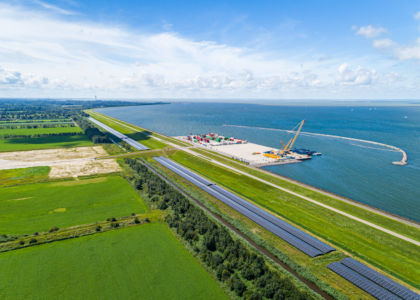
The Netherlands has suffered flooding on several occasions throughout its history. Following a disaster in 1953 which claimed 1835 lives, an elaborate flood defence system was built in the south west of the country. The Delta Works, as it is known, is a series of dams and storm surge barriers. As an additional measure, all tidal estuaries in the south west Province of Zeeland, with the exception of the River Schelde, have been closed. In the north of the country, the Zuiderzee works comprise a man-made system of dams, land reclamation and drainage works. The Afsluitdijk (meaning “closure dike”), completed in 1933, closed the Zuiderzee off from the rest of the North Sea, and created a fresh water lake known as IJsselmeer (IJssel Lake). It has enabled major land reclamation projects in Flevoland and West Friesland. The Afsluitdijk withstood the North Sea flood of 1953. Flood protection – and, with it, climate change – remains an important issue for the Dutch, however, due to the Netherlands’ ongoing vulnerability to rising sea levels and land subsidence.
The three largest cities in the Netherlands are in the provinces of Noord and Zuid- Holland. These are, in order: Amsterdam, the capital; Rotterdam, the world’s largest sea port; and The Hague, known in Dutch as Den Haag (literally “The Hedge”) or more formally as ’s-Gravenhage (the count’s domain), which is the seat of government. The area between these three cities, together with Utrecht to the east, is known as De Randstad.
The Hague has a population of 445,000, including many expatriates. Situated on a sandy plain four km from the North Sea coast, it is the centre of Dutch political life and home to the royal family. Several multilateral institutions and international tribunals are located there.
The Netherlands has a maritime climate with mild winters and, usually, mild summers. The period from February to May is the driest. Despite its relatively small land area, the Dutch climate can vary slightly from region to region. The average minimum temperature in the east is 1° C lower in the winter and 2° C higher in the summer than on the coast. The amount of rainfall also varies. In June an average of 50 mm of rain falls in the north-west, whilst the south-east of Limburg receives 75 mm during the same month. An average of 80-90 mm of rain falls on the Friesian Islands in October-November and about 55-65 mm in the north of Limburg. From June to September, the coast has more sunshine hours than the rest of the country.